
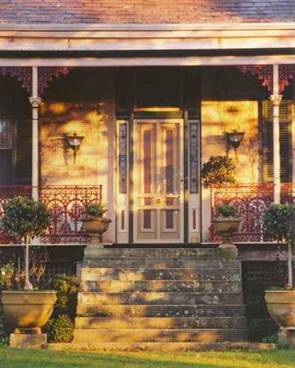
 Welcome to Ulinbawn, one of the
early residences of the
Welcome to Ulinbawn, one of the
early residences of the
Ulinbawn is part of our heritage and is listed by the
the National Trust, the NSW Heritage Council and the
Blue Mountains City Council.
The first road across the mountains, built by Cox in 1815, made its arduous
ascent of the escarpment only a few metres from where Ulinbawn
was later to be built. It was abandoned in 1824 for an easier route. In the
1860s came the railway, which, by means of the Lapstone
Zig Zag, established a
practical transport route to the interior. Up to this time the mountains were
an obstacle to be crossed, but with the comfort and ease of the train came an
interest in the mountains in their own right as a place to visit or settle.
The Hon. John Lucas, MLA, was a colourful politician of the period who
purchased from the Crown several parcels of land on the escarpment overlooking
the
The name “Ulinbawn” has been associated
with the house from the early times and is known to have a connection with the Doyle
family who were early settlers at Sackville Reach and brought this name from
their family home in
The house is constructed of local sandstone with welsh slate roof. Features
include verandahs and large shuttered windows on the
front and northern sides. Not much is known about the earliest years of the
house but, it is said that with the opening in about 1877 of a nearby railway
platform, known as Breakfast Point, the house became associated for a period
with the serving of refreshments to the tourist trains which stopped at
Breakfast Point to admire the panoramic views over the Nepean district.
Glenbrook's development in the 1870s and 1880s owed much to its new accessability and to its renowned climate, in those days
said to be the finest in the colony. In
the 1880s and 1890s Glenbrook was a small community with several boarding
houses, It was a popular destination with visitors, particularly during the
summer months.
Mr George Yeomans, a station overseer from the Walgett region, purchased the property in 1883 living here
until the early 1900s. The painter Arthur Streeton,
when residing in Glenbrook in 1891, described Mr Yeomans
in a letter as "a squatter living here - by nature and religion a
naturalist - is very nice to me - dined with them on Sunday - very nice
people". Some extensions to the
house were made to the “already comfortable dwelling” in 1885.
With the closure of the Zig Zag
and relocation of the railway in 1892 the vicinity of Ulinbawn
became more isolated, the only access being by a track leading to
Ulinbawn was leased and occupied by Donald and Thomas
Skarratt from 1906 or earlier until Donald purchased
it in 1910. He also purchased and moved into the nearby residence Mountside built 1885. Before this the Skarratts
had come from Kington in
Ulinbawn was known as the "
With the takeover of the nearby old Lapstone Hill
Hotel by the RAAF after WW2, Ulinbawn was used to
billet RAAF personnel. The kitchen was relocated to the main part of the house
and a bathroom was added in the 50s or early 60s. The house otherwise changed
little from its early years until the 1960s at which time the property was
subdivided and the house, which suffered from age and neglect, awaited care and
attention.
From the 1960s there have been renovations by various owners, yet the basic
layout and appearance of the house remains much as it was in the early years.
Significant changes were made in the 1970s by the then owners which,
nevertheless, retained the essential features and charm of the house whilst
making for a practical and liveable home.
The present owners enjoy the character of the house and are keen to know more
of the stories it has to tell. We have put together a more detailed history of
the house and would appreciate hearing any recollections, no matter how
trivial.
E-mail contact:
